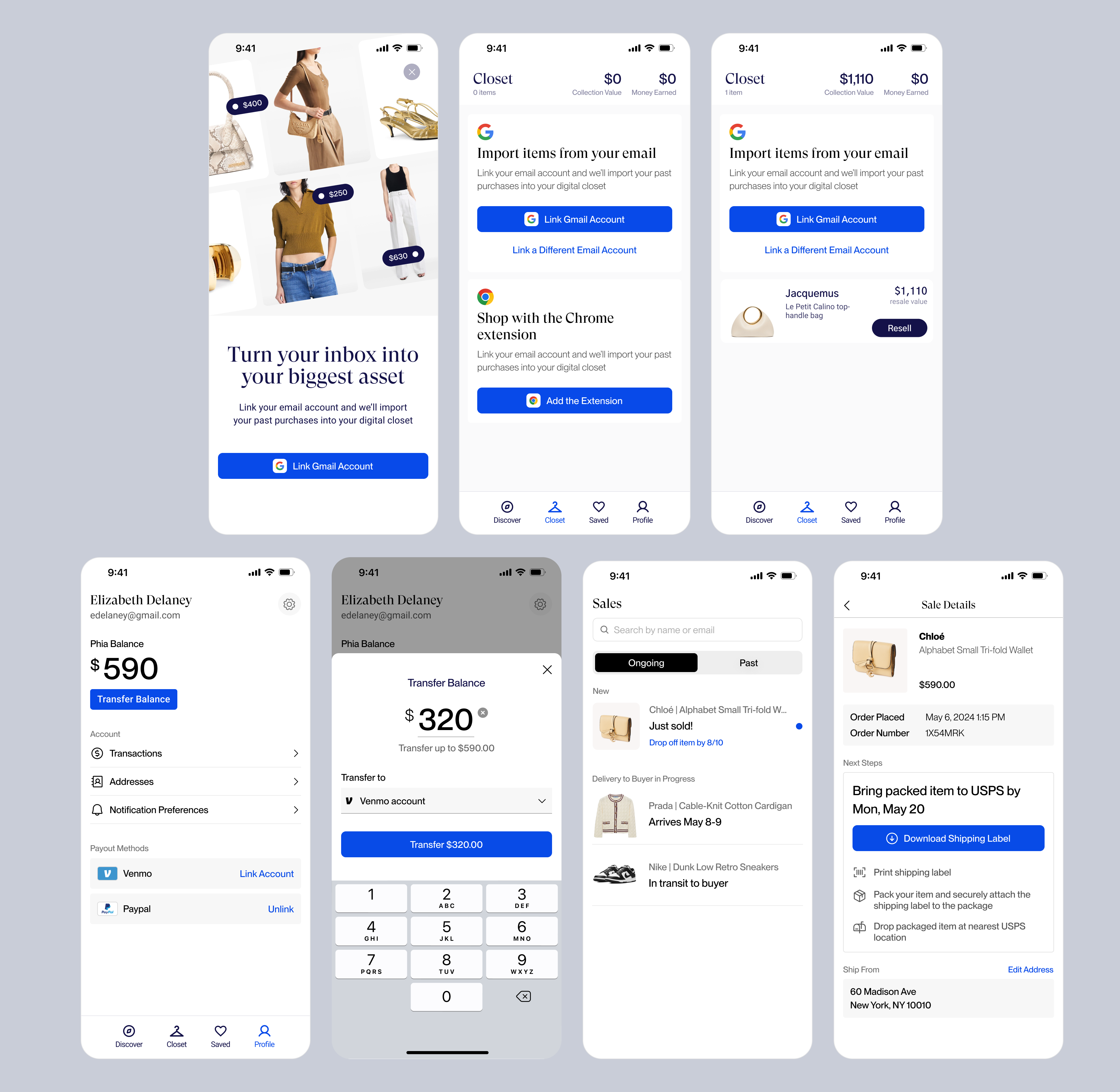
01 — Context
A resale app where the seller experience is the product.
Phia's model is built on commission revenue from partner resale sites. That means the seller experience — uploading items, managing listings, shipping sold items, and getting paid — is the core product. If any of those steps is confusing or breaks down, the business model breaks down with it.
I was brought in to design three flows that sit at the heart of that seller journey. I started by writing a brief that defined the user goals, business goals, and success metrics for each flow before designing anything. That foundation shaped every decision downstream.
The brief I wrote covered four distinct success metrics for each flow: task completion rate, time on task, error rate, and retention. Designing to those metrics meant treating every edge case as a product problem, not an engineering footnote.
02 — Email linking flow
Getting items into the closet without friction.
Before a user can sell anything, they need items in their digital closet. Phia pulls purchase history from Gmail automatically — but only if the user links their account. The email linking flow had to handle two distinct states: users who had already shopped with the Chrome extension (and already had items pre-populated) and users starting from scratch.
The key design decision was making the distinction between those two states visible before the user tapped anything, so the CTA they saw matched their actual situation. A user with pre-existing items shouldn't see an empty-state prompt that implies they have nothing.
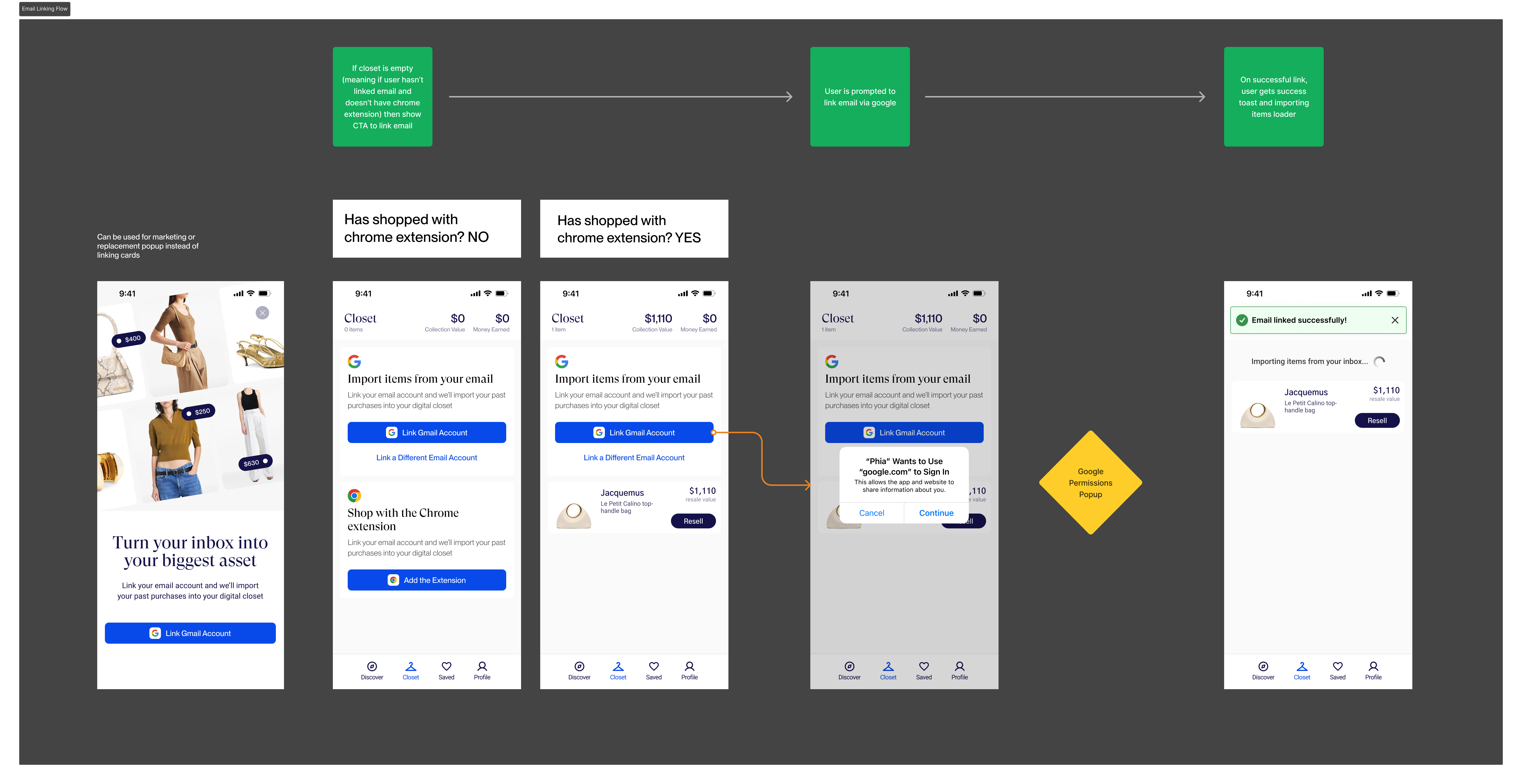
Email linking flow — two entry states, Google OAuth prompt, and success state with items importing. Edge case noted for marketing reuse of the linking card.
03 — Shipping flow
From sale notification to package dropped off.
When a seller's item sells on a partner site, a lot needs to happen quickly. The seller gets notified, needs to understand what sold and for how much, download a shipping label, pack and ship the item, and track delivery. Each step is a potential drop-off point.
The flow I designed walks the seller through each step sequentially — notification to sale details to label download to tracking — with clear next steps at every screen. I documented edge cases that needed engineering answers before we could finalize the design: what happens if the seller needs to update their address? Can they reject a sale if the item is no longer available? What if the shipping label scan fails?
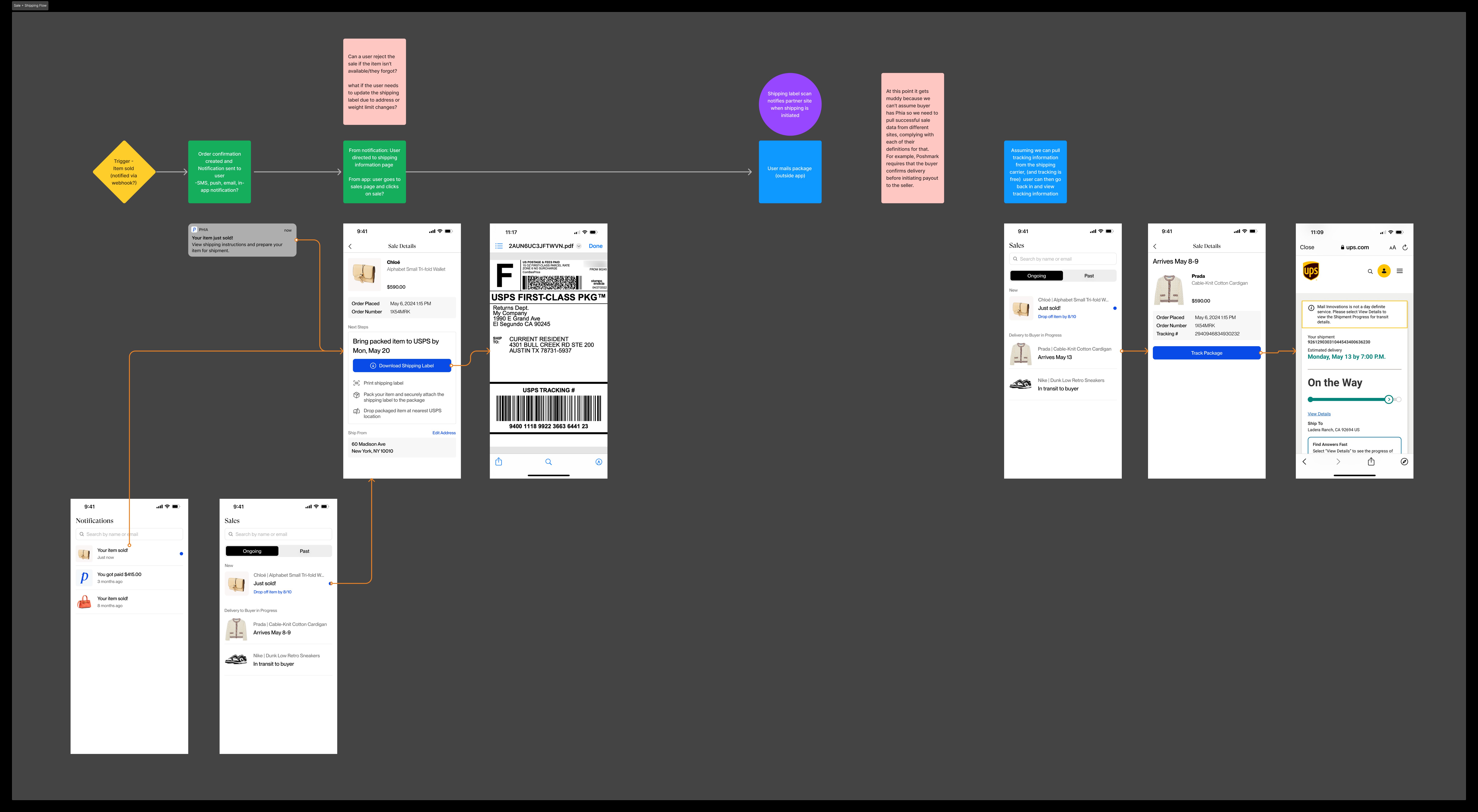
Sale to shipment flow — from webhook trigger through notification, label download, shipment, tracking, and payout initiation. Edge cases flagged for engineering in pink annotations.
04 — Payment flow
Getting paid should feel like a reward, not a task.
The payout flow is the moment the seller sees the value of the platform. I designed it to start with the notification — "You just got paid $590" — and make it as easy as possible to get from that notification to money in a Venmo or PayPal account. The profile page surfaces the Phia balance prominently, the transfer modal is a native number pad rather than a text input, and the transaction detail links back from the notification directly.
I also accounted for the "no accounts linked" state — a seller who receives a payout notification but hasn't set up a payout method yet. That state needed to prompt account linking without blocking access to the payment details they'd just received.
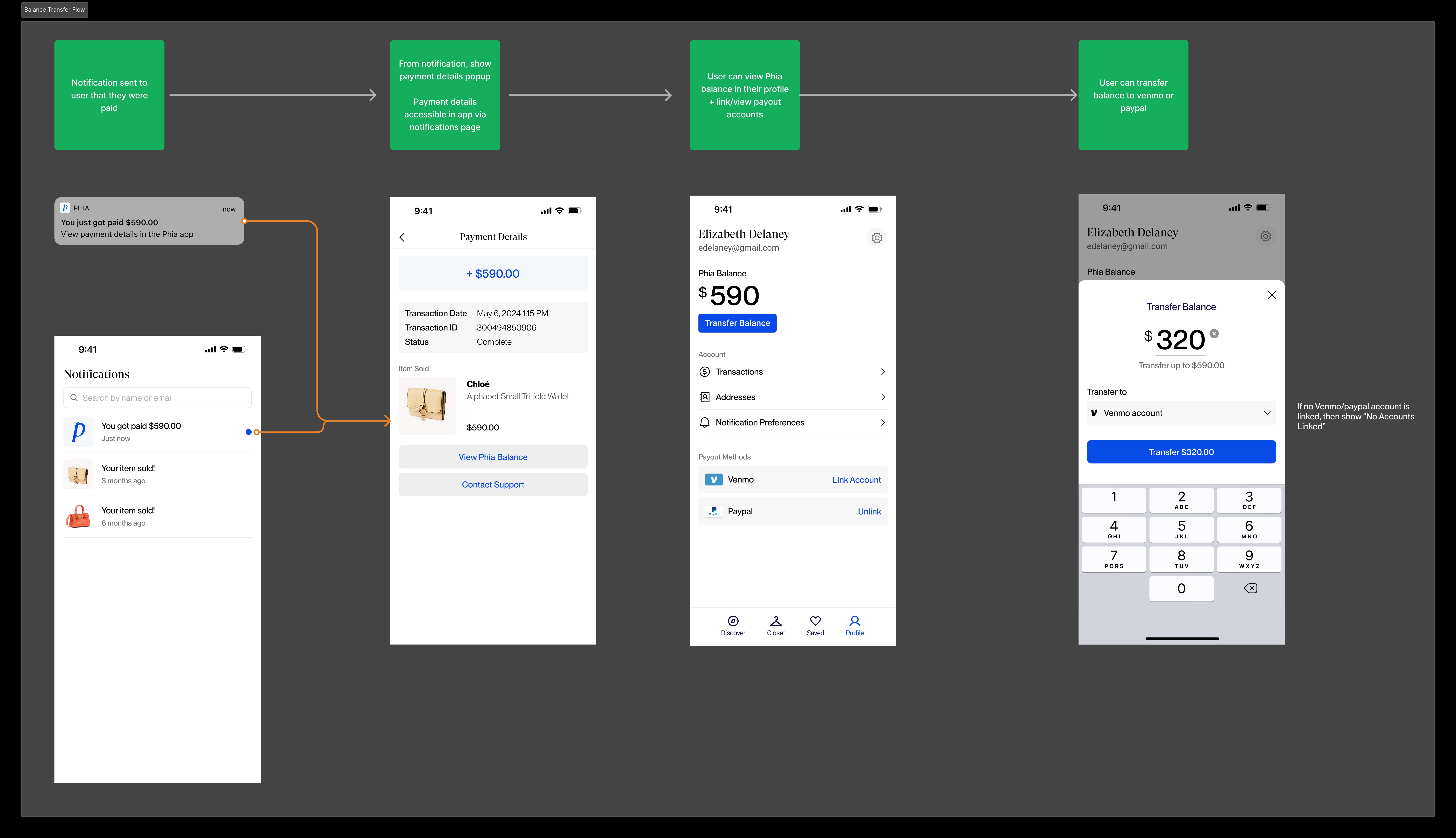
Balance transfer flow — notification to payment details to profile balance to payout. Edge case for no linked payout account annotated at right.
05 — Reflection
What I'd do differently with more scope.
This was a focused freelance engagement — I owned the flows, not the full product. A few things I'd want to explore with more time and access:
User research before the brief
I wrote the brief based on my understanding of resale seller behavior and the business model. Real seller interviews — especially with people who actively sell on Poshmark or Depop — would have sharpened the success metrics and surfaced pain points I couldn't anticipate from a brief alone.
The broader seller journey
Shipping and payout are the end of the seller flow. I'd want to understand how those flows connect back to the listing experience and whether the handoff between them creates any confusion or drop-off. Three isolated flows can be well-designed individually and still break down at the seams.
What this taught me about marketplace design
Every flow in a two-sided marketplace has a buyer side and a seller side, even when you're only designing one of them. The shipping flow is a seller experience, but the buyer is waiting for that package. Designing the seller flow well is also designing the buyer's trust in the platform.